Sunday, September 25, 2005

Wandering from London to the Lake District

On day two of our trip, I stopped at the train station to purchase tickets for our trip from Sevenoaks to the place where we were going on our walking holiday in the Lake District. The ticket agent was very meticulous and checked not only the electronic information but also the paper files and also went to check with a supervisor or at least someone else in the back office. He typed information into the computer one finger at a time and held his finger over the key while he checked back to his source material. In spite of all that, he did make an error and had to start over at one point. I was beginning to think it might be faster to walk to the Lake District than wait for the ticket but I was wrong. Anyway, we got our tickets which took us 1. by train to London, 2. by subway from one train station to another, 3. by train to somewhere up north, and 4. by a local small train to Windermere train station. From there we were on our own to either take a taxi or bus to Monk Coniston, the Holiday Fellowship house where we were booked in for a walking holiday. Since our train travel day was a Saturday, we did not have to put up with the usual weekday commuters and our trip through the London subway system was not too bad except for hauling heavy suitcases up and down steps. At least it was not too crowded at 8:00 in the morning.

When we got off the train at Windermere, we discovered that the cash machines in the village did not take our debit or credit cards. We had just enough cash to make the bus trip but not much more. The bus was a standard size bus like one might see in the U.S. or Canada but the roads were not much larger than a single lane. Due to hedges and stone walls at the sides of the roads, we had to stop often to let cars or trucks inch by the large bus on the narrow roads and at one point three cars had to back up to a wider spot in the road for the bus to inch past. When one adds a few pedestrians and bike riders to the mix, it was a bit of an adventurous ride on the bus.

Églantine spotted the sign for Monk Coniston as we rode along the road and asked the bus driver if he would stop to let us off. As we were 2 of only 3 people on the bus, it was no problem so her quick thinking saved us a mile walk back to the house.

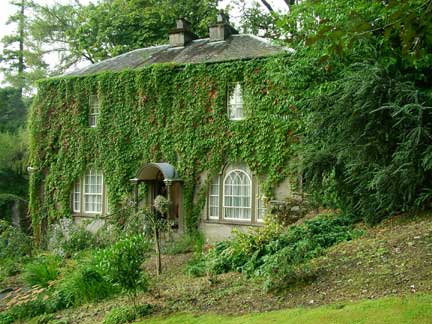
Below is a photo of the main house of Monk Coniston.
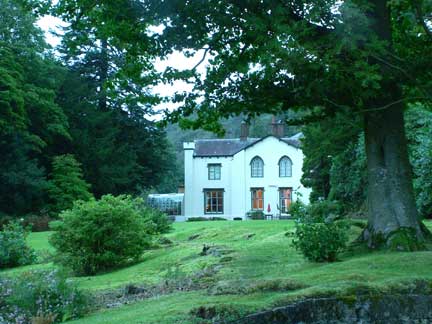


Monk Coniston is a National Trust building that once belonged to Beatrix Potter of Peter Rabbit fame. In its earlier life, the house was an abbey where monks stayed to oversee a large plot of land and farmers rented the land. We did not stay in the main house but in the counting house where the farmers came to pay the monks their yearly rent. Our room was behind the window on the second floor on the right.


The yard, in front of the main house, overlooked the village of Coniston and the body of water called Conistonwater. (A trivia question given by one of the hike leaders was, "How many lakes are in the lake district?" The answer was, "one." Only one body of water has the name lake. All the rest are "mere's" or "waters.") In the photo below, Conistonwater is hidden behind the trees.


The organization that we booked our holiday with is called "HF Holidays."

Teachers' Travel Service Ltd. of Toronto Canada is the HF North American Representative if you are interested (email: info@teacherstravel.com). I'll give the URL's again after the end of this series of blogs.

Here is a second view from the front yard of Monk Coniston. This one shows Conistonwater and some of the hills that we walked on our holiday.

Saturday, September 24, 2005

Wandering in London - Day 2

For our second day in London, we bought a new kind of train ticket. Instead of getting a return ticket to Sevenoaks, we bought a ticket that was good for both the train to and from London and for the tube (subway). That meant that we could wander about London on the subway system as we chose. Actually, we did not wander too much as we had only two stops on our agenda. The first was the Victoria and Albert Museum. Although both Églantine and I have been lucky enough to have had several trips to London and visited many of the museums, this was one that we both had missed. I thought there was probably a reason I had missed it and was not sure I wanted to go but went anyway and had a wonderful time. Again, we could easily have spent all day and still missed much but on this occasion we set a time limit as Églantine wanted to go to the National Portrait Gallery too. So, into the V&A we went and found, to our delight, that photos were allowed in all but one room. Sculptures, iron works, and glass made up the most of the 100+ photos that we took on day 2. Following are a very few examples of each:


This glass piece hung above the main entrance to the museum. I did not find the dimensions but, having just checked the V&A Website, I just found out the name of the artist: Dale Chihuly.


There were two types of sculptures in the V&A. There were originals and there were copies. Michelangelo's David was a plaster copy; however, one could photograph the copy while it was forbidden to photograph the original in Florence, Italy. The V&A had many other famous sculptures as plaster copies but the most amazing, in my opinion, was a plaster cast of the 30 metre (100 foot) tall copy of Trajan's column from Rome. (Since this copy has been inside the museum for year, it is probably in much better condition than the original that has been standing outside in acid rain for years!)


Imagine taking your bags of plaster down to Rome to make a copy of a 30 metre column.... It boggles my mind. At least they broke it up into two parts.


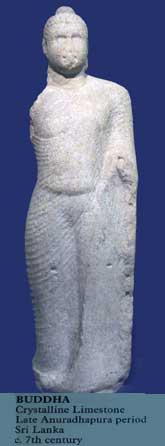
This Buddha was an original.


This sculpture of an old man was a favourite of Églantine. (She has it on her Flicker site in different colours.) I have no idea if this was an original or a copy but it was well protected behind glass.

Speaking of glass...


I really liked this glass table. I have no idea how the artist got the lights to work.


I think this piece was called Daisy Seed. It was a favourite of both Églantine and I.

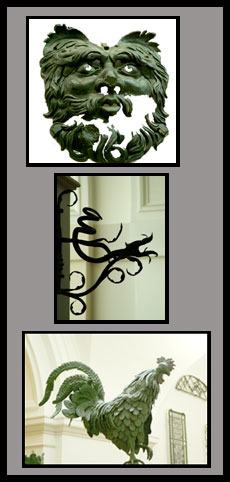
The other section of the museum where we spent time and took many photos was the iron section. The iron works were from various periods of time from ancient to modern. Below are several of our favourites:


We managed to get out of the V&A by 3:00 p.m. for a very late lunch at a place near Covent Gardens Market called Bistro 1. Our Sevenoaks friend told us it was the best meal in London for an inexpensive price. It lived up to its reputation.

After our late lunch, we went to the National Portrait Gallery. Portraits, in general, do not excite me much but I did find the more contemporary portraits of interest and even bought a book of them. Again, cameras were not to be used, but the NPG does offer CD's of many of their portraits and many are available, in a small format, to see on line. On of the neat contemporary portraits that we enjoyed was that of JK Rowling. Photographs do not do it justice as it was a 3-D construction with great perspective and with lights inside the picture to create wonderful shadows and light on Ms Rowling.

It was another late afternoon train ride back to Sevenoaks.

Friday, September 23, 2005

Time out for the Equinox

I shall write more about the wanderings in England later today, I hope. Meanwhile, here is my sun photo for the fall equinox with a pasted in sun from the summer solstice for comparison. (I'm glad we don't have the 90 degree weather of the southern U.S.!)

Wednesday, September 21, 2005

Wandering in England, Day 1 cont.

Given that we spent so many hours in the Tate Modern, the following is a very small showing of art but we could not take photos and they take a long time to download on our rural line. Besides that, you may not be interested anyway. So, with that said, below is work from one of my favourite sculptors, David Smith:


The above work is called Wagon II and was made in 1964. It is 2.73 m (9 ft.) x 2.83 (9.3 ft.) x 112 m (3.6 ft.).


The work above is another piece by David Smith. It is called Home of the Welder and is a desk top size. I forgot to write down the size. Someday I hope to work in metal but right now my lack of welding skill slows me down. I am reduced to drilling holes and bolting things together.


This piece by Cy Twombly (Quattro Stagioni: Primavera) was in the same gallery as the works by David Smith and was one of Églantine's favourites. She liked the colour, the fact that all the canvas was not painted and the use of words on the painting. It, and the following work, was over 3 m (10 ft.) tall.


This second piece by Cy Twombly (Quattro Stagioni: Autunno) was the one part of the four piece work that I liked the best. Both the colours and the drip technique made the work interesting for me.


Both Églantine and I enjoyed Karel Appel's Mensen, vogels en zonnen (People, Birds and Sun). Again the bright colours captured us as well as the technique used of initally painting without thought and then looking to see what was there and emphasizing that.


Kandinsky has been a favourite artist of mine for quite some time. It is always a treat for me to see what he can do with geometric shapes and colour! Sorry, I forgot to write down his title for this work.


This sculpture was huge. The tallest part was originally the height of the Berlin Wall and was part of an installation not far from the wall in 1982. Knowing, in a very rough way, the cost of casting items in bronze, I was most impressed with the scope of this work. I found the smaller bits, lying about the floor of the gallery less inspiring but still worthy of some thought. I spent a good half hour sketching this work to help me appreciate it. The work is called Lightning with Stag in its Glare and was made by Joseph Beuys.


This last work was also the last of a tour that Églantine and I took. The sculptor started with a long beam of wood and used a chainsaw and the hammer and chisel to tease out the original tree from within the beam. I have seen, in rotting trees, the early bits and pieces of limbs that were harder than the outside wood, but finding them in a beam and carving down to them was an amazing piece of detective work in my estimation. The work was so tall that it had to be cut in half to fit into the large gallery. It is called Albero di 12 metri (Tree of 12 metres) [39.4 ft] and was made by Giuseppe Penone.

Tuesday, September 20, 2005

Wandering in London, England Day 1

Having stayed the night in Sevenoaks, a small village south of London, Églantine and the Ontario Wanderer took a train into Waterloo Station in London. We looked briefly at a map and then just walked in the general direction of the Thames. All one can do in London is move in general directions. The compass was not yet invented when London was established and Napoleon never got to redo London with straight streets. In a few minutes we did find the Thames and started downstream towards our goal for the day which was the Tate Modern Art Gallery. We made a few photo stops along the way for sculptures, buildings, reflections in the Thames and in store windows. It was nearly 11 a.m. when we arrived at the Tate Modern and we just stumbled into a guided tour of part of the art history section of the gallery. After the tour we were on our own wandering about the gallery. It says something about both us and the gallery to note that we were surprised to be kicked out of the gallery at 6:00 that evening having forgotten to eat lunch or attend any of the other tours that we had intended to take in.

Photos were not allowed inside the gallery but information and photos abound on the internet. According to the introductory page of the Tate Modern web site, they have 65,000 works on line. One could spend many days wandering through the internet galleries of the Tate Modern so our 7 hours were a tiny, tiny drop in the bucket.

Art, and art appreciation, are very personal. I am sure that some paintings and sculptures that I love would make you scratch your head and wonder about my sanity and, of course, the reverse is true also. Regardless, I plan on showing a few of the paintings and sculptures that Églantine and I enjoyed. You, as the reader, are free to move on to other blogs or have a look and comment if you choose.

First, two quotes from artists that were in a book that I bought:

"Then the sun rose and was so dazzling I found it impossible to see. The Thames was all gold. God it was beautiful, so fine that I began work in a frenzy, following the sun and its reflections on the water...I can't begin to describe a day as wonderful as this. One marvel after another, each lasting less than five minutes, it was enough to drive one mad." Claude Monet in a letter to Alice Monet in February of 1901.

"The man who wants to shoot a cloud down with an arrow will exhaust all his arrows in vain. Many sculptors are such strange hunters. What you have to do is fiddle something on a drum or drum something on a fiddle. Before long the cloud will descend, roll about on the ground in happiness, and at last complacently turn to stone." Jean Arp, 1956

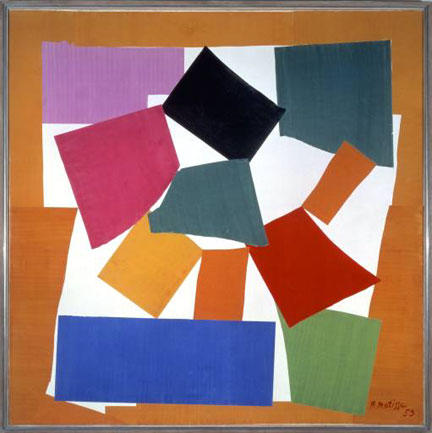
One of our first stops in the Tate Modern was at the feet of a 2.8 metre (9.4 foot) snail.


Henri Matisse - L'Escargot - The Snail - 1953

To be continued...